CA to CAA 2019
Bill, Act, Rules/Regulations, Notification
An act is first presented in the
Lok Sabha (LS, lower house) as a “Bill”, after passing it there, it is tabled
in Rajya Sabha (RS, upper house). The Joint Parliamentary Committee (JPC) may also
screen and provide suggestions on bills, but all of their recommendations may
not be always incorporated. Once the bill gets passed in both houses, it
gets the President's node and thus becomes an “Act”. The Committee of
Subordinate Legislation, senior legal experts and bureaucrats create rules and
regulations for the act, and the act is “notified” with these details. Most of
the time the notification of the act happens within 6 months of the President's
node.
Citizenship Act
India formed its Citizenship Act (CA) in 1955, which
envisaged citizenship in the following ways:
·
By Birth – A person born in Indian republic
·
By Registration – a person applies for Indian
citizenship and it’s granted by the union government. This does not apply to
illegal migrants.
·
By Descent – people born outside India, to
Indian parents, but do not hold a passport of another nation
·
By Naturalization – if one lives in India for 11
years
·
By Territorial Incorporation – like assession of
Sikkim
Panditji leads this legislation,
keeping high humanitarian values. He and other tall leaders wanted to envisage
India as a hope for suffering people around the world. We wanted to open our
doors for the needy non-criminal people during their sufferings. If the
situation in the source states is better and the people want to return, it
is also supported.
Citizenship (Amendment) Acts
Citizenship Act (CA) was amended on several occasions, known as CAA - Citizenship (Amendment) Acts:
- CAA 1986 – by birth citizenship was restricted, and only if one of the parents was a valid citizen of India at the time of the birth, the kid was granted citizenship. Almost all parties supported this amendment, during Rajiv Gandhi
- CAA 2003 – This amendment made it more stringent so that only if both the parents are Indian citizens, the newborn is granted citizenship, based on a strict blood relationship. It also restricted an illegal migrant from gaining citizenship, even if more than 7 years he/she is resident of India. This amendment was during the third Vajpayee ministry. During the discussions, Dr Manmohan Sing (leader of the opposition) invited the attention of L K Advani (home minister) regarding the religious persecution of minorities in Bangladesh.
- CAA 2015 – Merged Person of Indian Origin (PIO) to Overseas Citizen of India (OCI) and introduced Overseas Citizen Card Holder. This amendment was added during the first Modi ministry.
- CAA 2019 – permits 6 communities (Hindus, Sikh, Buddhists, Jains, Parsis and Christians) entered from 3 neighbouring countries (Pakistan, Bangladesh and Afghanistan) before 2014 Dec 31st to continue in India. This clause was in the assumption that these 6 communities are experiencing prosecution in these 3 countries and to legalize their illegal migration till 2014. This act exempted such migrants from the Passport Act and Foreigners Act to protect them from considering illegal migrants. Along with this, this amendment reduced the naturalization period from 11 years to 5 years.
Refer: https://indiankanoon.org/doc/305990/
Before CAA 2019, the rules and regulations of the below acts were amended to include similar restrictions during 1998 – 2004, by the Vajpayee ministry. Alongside the jail term of illegal migrants was increased from 3 years to 5 years. But this has not attracted any protests as it was not part of the act
- The Passport Act
- The Foreigners Act
ADC, ARC, ILP and relaxation of CAA 2019
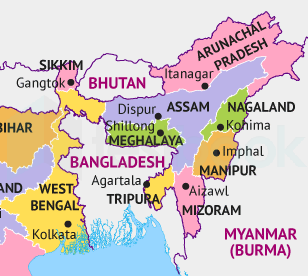
The exceptions added in CAA 2019 are exempted from ILP and Sixth Schedule areas. Effectively CAA 2019 is now applicable only to around 60 % of Assam only in the North East
- Inner Line Permit (ILP) areas are notified tribal areas. Arunachal Pradesh, Nagaland, Mizoram and Manipur come under ILP. Manipur was added to this list in 2019
- Autonomous District Councils (ADC) and Autonomous Regional Councils (ARC) are tribal communities of governance in the states of Assam, Tripura, Meghalaya, and Mizoram (sixth schedule states). These councils get precedence over union government in many fronts.

Image: https://d18x2uyjeekruj.cloudfront.net/wp-content/uploads/2020/12/ilp.jpg
NPR and NRC
NPR - Residents contain
citizens and non-citizens. The National Population Register (NPR) first prepared in
2010 and then updated in 2015. It is a data of usual residents of India, who
live in a locality for around 6 months or is about to stay there for about 6
months. NPR is not directly prepared based on census data; independent
enumeration is performed.
NRC - National Citizen
Register (NCR/NIRC/NCR) first appeared in discussions during 1951, as part of the Nehru–Laquat pact and the first census on Assam. NRC is only prepared for Assam,
during the 1951 census. It is not decided yet, when or whether to prepare NRC for
the entire India.
Example: A Japanese student doing regular study in an
Indian college for 3 years may appear in NPR, but not in NRC
The Registrar General of India under the Union Home Ministry of India is overseeing the below
- Birth and Death Registration Act 1969, records births and deaths in India.
- Census – data compiled by nationwide enumerators who collect data based on a pre-defined questionnaire, every 10 years starting from 1951. Registrar General acts as Census Commissioner
- NPR is also overseen by the Registrar General of the Union Home Ministry
- NRC - The Registrar General of India acts as Registrar General of Citizen Registration
Political Context
Independence and Partition
The partition of India gave
birth to segments of Pakistan, the current Pakistan and East Pakistan, (current
Bangladesh).
The people of the East Pakistan
were speaking Bangla and was dominated by Muslims. Religious prosecutions, lack
of livelihood, better opportunities, etc triggering illegal migrants from East Pakistan. West Bengal and most of the tribal states of the northeast were
affected by this. The cultural and social order of them was shaken by the
Bangla-speaking migrants in high numbers. Assam was one of the most affected
states, which was affected by violent protests against this migration.
Nehru – Liaquat Pact
In 1951, as per the Nehru–Laquat pact or Delhi pact, it was aimed at returning the illegal migrants back to East Pakistan. National Citizen Register was envisaged to identify valid Indian
citizens of India in Assam, for this purpose. But, in parallel, the illegal
migrations used to continue in volume to India from East Pakistan. Unlike
its western borders, India was lenient to the eastern borders due to
humanitarian and political reasons, at that time.
Bangladesh
Later in 1971, East Pakistan was liberated as Bangladesh. The political and humanitarian context changed by the freedom of Bangladesh and India eventually decided to go strict on the illegal immigrant issue from Bangladesh. During the civil war and the independence movement, migration was at its peak, even after that, the inflow was not getting reduced.
Image: https://storage.googleapis.com/tb-img/production/21/02/bhutan.PNG
|
|
|

IMDT Act
In 1979, the Assam Movement
was launched against illegal migration.
The Illegal Migrants
(Determination by Tribunals) (IMDT) Act was introduced in 1983 by the Indira Gandhi
ministry, specifically for Assam to detect and expel illegal Bangladeshi
immigrants from Assam. It also suggested special protection for minorities
affected by Assam Agitation. IMDT act was specific to Assam and the rest of the
Indian states were supposed to abide by The Foreigners Act.
Supreme Court of India nullified
the act in 2005, saying that the conviction rate is less, though the union
government argued that it wants to expel people only lawfully.
The Assam Accord
In 1985, during Rajiv Gandhi's ministry, the Assam Accord was formed to normalize the illegal immigrant issue in the context of the birth of Bangladesh and the Assam Movement. It was decided to deport the illegal Bangla-speaking immigrants to Bangladesh, with a high-level compromise package
- People entered Assam from Bangladesh on Jan 01, 1966, which was considered as a year for determining foreigners. Residents before this date were regularized
- People entering Assam between Jan 01, 1961 and March 24, 1971, were allowed to request for citizenship but, to be barred from electoral rolls till 1981. The Assam NRC was to use March 24, 1971, as the cutoff date
- All refugees and migrants after March 25 1971 decided to be deported to Bangladesh
The Assam NRC
Though Assam NRC was planned, the
union government was not actively acting on it, mostly due to humanitarian
concerns and was trying a slow route. The government selected two pilot districts
in 2010, but the process was halted due to protests. Though it strengthened the
eastern border, it was not taking any aggressive steps that may lead to mass
deportation.
Later the Supreme Court of India interfered and a reputed IAS officer Prateek Hajeela was directed to oversee and complete the Assam NRC process.
- 3,11,21,004 (3 crores plus) people were included in NRC
- 19,06,657 (19 lakh) people were excluded from the NRC (less than half of the first draft of 41 lakh people), which includes:
o
63 % non-Muslims (above 12 lakhs)
o
37 % Muslims (around 7 lacks)
Refer: https://thewire.in/rights/detention-criminalisation-statelessness-the-aftermath-of-assams-nrc
CAA 2019 and Assam NRC
The 2019 amendments of CAA are
mainly aimed at protecting the 63% non-Muslims in the final draft of Assam NRC.
This move is being objected to on several fronts
- · In Assam, the resistance is against protecting a section of the NRC
o
Only 30% of Assam is exempted from CAA 2019 (ILP
and Sixth Schedule)
- · In the rest of India, the protests are against
o
Adding a religious angle to the problem and
constitution, it is against Article 14, Article 65 etc.
o
Excluding many known minorities - Jews, Shia,
Ahammedia, Sufi, etc.
o
Questions on why 6 communities, from 3 nations
and on what basis 2014 was decided as the cut-off year selected etc.
The amendment was first presented
as a bill in Lok Sabha in 2015 but has not passed the Rajya Sabha. Hence, it
was re-introduced in 2019, as a bill again. The Indian National Congress and
most of the opposition boycotted the parliament session in protest since they
did not have enough numbers to fail the bill. The bill became an act in
2020, but the rules and regulations were notified, siting the COVID pandemic. There
was speculation that the 2022 assembly elections of Assam were the real reason
for not notifying the act then. The notification later came in March of 2024,
ahead of parliament elections.
Electoral Advantage Aims of Right-Wing
We can see from the evolution of CAA; that the BJP has been consistent in shifting Indian Citizenship from a relatively open
birth-based one to a relatively closed blood relationship-based one. Another
aspect of the change is that the onus of identifying a citizen has been
transferred from state to individual.
The 2019 amendment would have been a
normal one if it was only aimed at protecting the minority sections fighting
persecution in neighbouring countries. The callout of 6 named communities from
3 named Muslim countries is a deliberate attempt to give religion colour to
citizenship. In fact, the suggestion came from the Joint Parliamentary Committee
(JPC) by Subhash Kashyap but was not considered.
The far-right capital-driven
organizations like RSS and BJP may benefit in elections from the
polarization and mistrust created out of the protests against CAA. This may be
an immediate motive of notifying CAA 2019 rules and regulations, just before
elections. The rehabilitation of non-Muslim migrants for electoral gains
may also be speculated as a long-term goal.
Who is Affected?
The CAA 2019 amendment only
affects the people who are not on the Assam NRC list now. It does not affect any
citizen outside Assam now.
The speculation is that, if NRC
is rolled out to the entire nation and CAA is applied to it, the Muslims will be
affected them. But that remains mere speculation, as Modi ruled out NRC for
now.
Fear as a tool
Gandhiji advised us not to fear.
Fear generates anger and violence. Fear is used to oppress. In fact, fear
is forcing one to do oppression, most of the time the oppressed may be
fearless. An atmosphere of fear spoils
may lead to wrong decisions and conclusions. Hence it is very important to
resist fear. All who enjoy power and authority love to create fear to keep
their position. It is funny to see that they are subject to fear as they are
afraid of everything around them and express that fear as aggression.
Both the majoritarian outfits
like the BJP and minoritarian outfits like SDPI love to generate fear. An
atmosphere of fear and mistrust is good for them to achieve their capital and
material goals as people may be polarized based on fear.
CPIM also wish to fish from the
troubled waters and tries to utilize polarization in their favour. They
showcase violence to get the minority to consolidate for their electoral gains and are not much bothered about the divide it creates.
Hence,
we should realize the trap and have to be vigilant while taking up the resistance
against CAA 2019. Instead of heading violent protests against CAA 2019, putting
effort into regime change will be more beneficial. The Indian National Congress
takes a more humanitarian stand on such sensitive issues and generally do not
use force and urgency on sensitive matters.
Prepared based on online
sessions conducted by Ansulal Ponnarath for Sarvodaya Sangam conducted during
Mar 15 & 16, 2024


No comments:
Post a Comment